Cancer Prevention Month: Taking Action to Reduce Your Risk

woman eating healthy after exercising

Every February, Cancer Prevention Month serves as a reminder that while cancer remains a formidable health challenge, many cases are preventable through lifestyle choices and proactive health measures. With an estimated 2 million Americans diagnosed with cancer (excluding non-melanoma skin cancer) in 2024 and more than 600,000 cancer-related deaths, the urgency for awareness and prevention has never been greater.

The Preventable Nature of Cancer

Research indicates that more than 40% of cancer cases and nearly half of cancer-related deaths stem from preventable causes. These include smoking, excessive body weight, physical inactivity, and overexposure to ultraviolet (UV) radiation. This means that by making informed choices, individuals can significantly lower their cancer risk.

Proactive Steps to Lower Cancer Risk

  1. Quit Smoking (or Never Start) Tobacco use is the leading cause of preventable cancer. Smoking is directly linked to lung, throat, mouth, pancreas, and several other cancers. If you smoke, quitting is one of the most impactful steps you can take for your health. If you don’t smoke, avoiding secondhand smoke is equally important.
  2. Maintain a Healthy Weight Obesity is associated with increased risks of several cancers, including breast, colon, and pancreatic cancer. A balanced diet rich in vegetables, fruits, lean proteins, and whole grains, coupled with portion control, can help maintain a healthy weight.
  3. Stay Physically Active Regular exercise not only helps control weight but also reduces inflammation, regulates hormone levels, and boosts the immune system—all factors that can lower cancer risk. Aim for at least 150 minutes of moderate-intensity exercise or 75 minutes of vigorous activity each week.
  4. Protect Your Skin from the Sun Skin cancer, including melanoma, is largely preventable. Use sunscreen with an SPF of at least 30, wear protective clothing, and avoid indoor tanning. Limiting direct sun exposure, especially during peak hours (10 a.m. to 4 p.m.), is also key.
  5. Get Vaccinated Certain cancers are caused by infections. The human papillomavirus (HPV) vaccine can prevent cervical, throat, and other cancers, while the hepatitis B vaccine reduces the risk of liver cancer.
  6. Limit Alcohol Consumption Excessive alcohol intake is linked to an increased risk of cancers of the mouth, throat, esophagus, liver, colon, and breast. Moderation is key—guidelines recommend no more than one drink per day for women and two for men.
  7. Get Regular Screenings and Checkups Early detection saves lives. Routine screenings such as mammograms, colonoscopies, and Pap smears can detect cancer at an early, more treatable stage. Consult your doctor about recommended screenings based on your age, family history, and lifestyle.

The Bigger Cancer Prevention Picture

Many diagnosed cancers in the U.S. are considered preventable. While not all can be avoided, taking proactive steps can dramatically reduce risk and improve overall health. This Cancer Prevention Month, commit to small, meaningful changes that can lead to a longer, healthier life.

Highly Pathogenic Avian Influenza (Bird Flu) Detected in New London County

backyard chickens and ducks

The Connecticut Department of Agriculture (CT DoAg) advises that Highly Pathogenic Avian Influenza (HPAI) H5N1, or bird flu, was confirmed in a backyard flock in New London County on Wednesday, January 15, 2025. The backyard flock, consisting of chickens, ducks, and peacocks, were family pets, not commercial poultry, and had close contact with wild waterfowl in a nearby pond.

Samples were sent to the Connecticut Veterinary Medical Diagnostic Laboratory (CVMDL) for testing. The results from CVMDL were then confirmed by the United States Department of Agriculture National Veterinary Services Laboratory (NVSL) in Ames, Iowa. H5N1 is highly contagious among domestic poultry, and at this time, there is no effective treatment or approved vaccine for the virus in poultry. The infected flock has been depopulated to prevent the spread of the disease.

“Collaboration between state and federal partners is essential in preventing the spread of highly pathogenic avian influenza in poultry and safeguarding the health of our farmworkers,” said Agriculture Commissioner Bryan P. Hurlburt. “Through a united approach, we are able to swiftly identify and respond to protect our food supply and ensure the health of our communities.”

All poultry owners and producers are advised to enhance biosecurity protocols to protect their backyard and commercial poultry flocks against H5N1.

“Biosecurity is the best defense for a flock owner to protect their birds from disease,” said State Veterinarian Dr. Thamus Morgan, DVM, MPH, DACVPM. “This should be top of mind for commercial and backyard hobby owners – we must all work together – to reduce the risk.”

Biosecurity Tips

Poultry biosecurity materials and checklists are on the USDA’s Defend the Flock website. Best practices include:

  • Keep wild birds and rodents out of poultry houses and coops.
  • Don’t let poultry have contact with migratory waterfowl or other wild birds.
  • Wash hands and boots before and after entering the poultry area.
  • Buy birds from reputable sources to receive healthy birds.
  • Restrict traffic onto and off your property.
  • Have a written biosecurity plan in place.

Signs of H5N1 infection include a sudden increase in bird deaths, sneezing, coughing, nasal discharge, watery or green diarrhea, lack of energy, poor appetite, drop in egg production, swelling around the eyes, neck, and head, and purple discoloration of wattles, combs, and legs.

Flock owners are encouraged to report anything unusual, incredibly sick, or dead birds to CT DoAg at 860-713-2505 or [email protected] or the USDA at 866-536-7593.

Human Risk Remains Low

No person-to-person spread of H5N1 has been detected to date, and the Centers for Disease Control and Prevention (CDC) continues to assess the risk to the general public as low. Residents are reminded that properly handling and cooking poultry and eggs to an internal temperature of 165°F kills bacteria and viruses. No H5N1 virus detections in Connecticut have occurred to date in people, livestock, or other domestic animals. However, H5N1 continues to be detected sporadically in wild birds. Surveillance for cases in humans and animals is ongoing throughout the state.

“The current risk of infection from H5N1 to residents of Connecticut remains low.  While we have no evidence of human-to-human transmission at this time, we need to remain vigilant,” said Connecticut Department of Public Health Commissioner Manisha Juthani, MD.  “The CDC is currently monitoring numerous H5N1 cases throughout the country and tracking the spread of the virus in states where it has been identified in people or animals.

Read the DoAg Press Release Here

DMHAS, DPH Launch Toolkit for Help Facilities Treat Opioid Use Disorder

Person receiving support for opioid use disorder

The Connecticut Department of Mental Health and Addiction Services (DMHAS) and the Department of Public Health (DPH) have introduced a new resource to help long-term care facilities (LTCFs) better serve residents with opioid use disorder (OUD). The Strategies for Supporting Residents with Opioid Use Disorder in Long-Term Care toolkit provides a roadmap for delivering trauma-informed, recovery-oriented care to individuals with OUD.

The toolkit focuses on equipping LTCFs with best practices for addressing the unique challenges associated with OUD, including stigma reduction, staff training, harm reduction strategies, and partnerships with community-based resources. Healthcentric Advisors, a nationally recognized non-profit healthcare quality improvement consultancy, has been providing education, technical assistance, and project management services to DMHAS and DPH on the development and implementation of the toolkit over the past year.

“This toolkit gives long-term care providers the tools to deliver compassionate, high-quality care to individuals living with OUD.  Integration of behavioral health and long-term care will mitigate stigma and improve health outcomes for individuals living with a substance use disorder,” said DMHAS Commissioner Nancy Navarretta.

“With the opioid crisis impacting more individuals living in long-term care facilities, this toolkit delivers essential guidance to ensure facilities are prepared to support their residents living with OUD,” added DPH Commissioner Manisha Juthani, MD. “By prioritizing person-centered care, we can improve outcomes and foster recovery.”

Upcoming Webinar

DMHAS and DPH will host a webinar on January 22, 2025, to provide an overview of the toolkit and practical tips for implementation. Registration is open at this link.

Toolkit Availability

The Strategies for Supporting Residents with Opioid Use Disorder in Long-Term Care toolkit is available for download at this link. For additional resources, visit the DMHAS or DPH websites.

Additional Resources from Uncas Health District

DPH Stresses Importance of Radon Testing During Winter Months

In recognition of National Radon Action Month, which takes place in January, the Connecticut Department of Public Health (DPH) urges Connecticut residents to test their homes for radon gas, the leading environmental cause of cancer deaths.

According to the U.S. Environmental Protection Agency (EPA), radon is the number one cause of lung cancer among non-smokers. Overall, radon is the second leading cause of lung cancer. Radon is responsible for about 21,000 lung cancer deaths every year. About 2,900 of these deaths occur among people who have never smoked. However, experts say smokers exposed to radon do have a much higher risk for developing lung cancer.

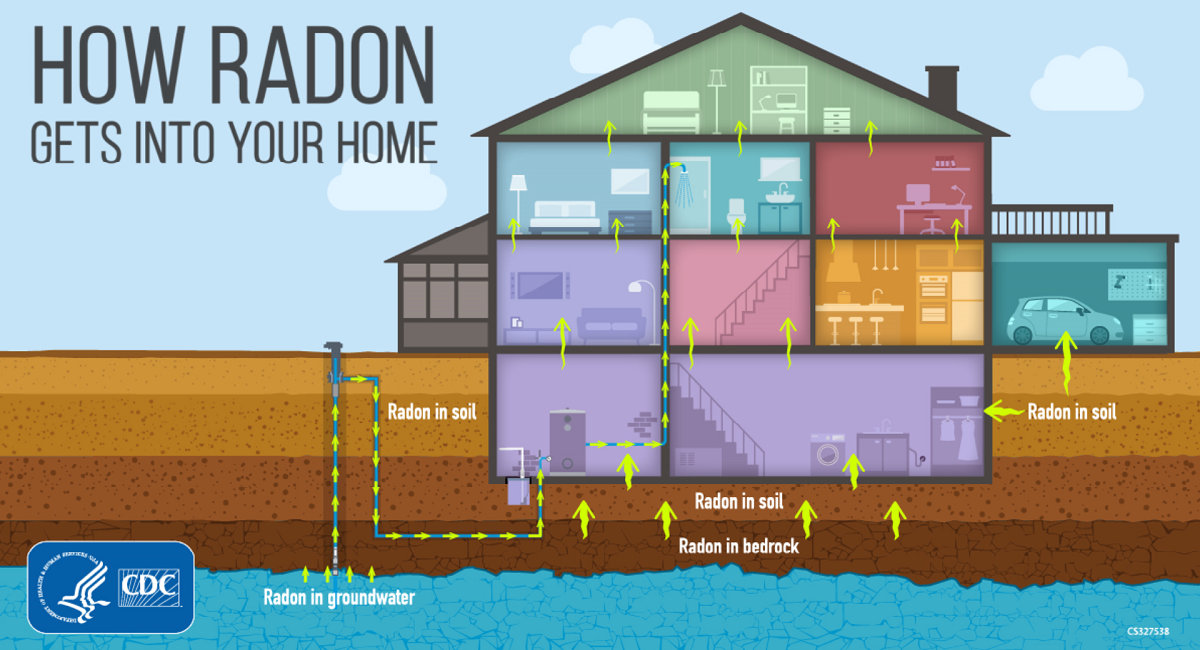
A naturally occurring, radioactive gas formed from the natural decay of uranium, radon is found in rock, soil, and water. While radon in outdoor air poses a relatively low risk to human health, it can enter homes from the surrounding soil or from well water and become an indoor air health hazard.

“Radon is a silent killer.  It is tasteless, odorless, and cannot be seen, leaving people unaware that it could be in their homes.  Testing indoor air for radon and reducing elevated levels is important and could save your life or the lives of your loved ones,” said DPH Commissioner Manisha Juthani, MD.


Graphic of a house with rooms sectioned out showing how radon enters the house. It enters through the soil at 3 points, through bedrock at one point, and through groundwater at one point in this diagram

The DPH Radon Program recommends that Connecticut residents test the air in their homes every two years. Testing homes for radon is recommended during the winter months and is simple and inexpensive. To support radon awareness, in 2024, DPH provided approximately 2,780 free radon test kits to 36 local health department partners for distribution.

Learn How to Get Your Free Radon Kit from Uncas Health District Here

Test kits can also be purchased from local home improvement or hardware stores or online from the American Lung Association by visiting their Radon Test Kit Store.

The EPA suggests fixing your home if it has high levels of radon gas (4.0 pCi/L or higher) to reduce the risk of lung cancer. If your home has medium levels of radon gas (between 2.0 and 4.0 pCi/L), you might want to fix this problem to lower your chance of getting lung cancer.  Mitigation is easy, effective, and can be relatively inexpensive.

Radon levels can be reduced by hiring nationally certified radon mitigation professionals.  For a list of nationally certified radon mitigation specialists or to learn more about radon, please visit www.ct.gov/RadonPros.

Recall Alert: Mochi Sorbet Product Recalled for Egg Content

The Mochi Ice Cream Company LLC, Vernon, California, is recalling 1350 cases of Peach Mango Sorbet because it may contain undeclared pasteurized cooked egg white. People who have an allergy or severe sensitivity to eggs run the risk of serious or life-threatening allergic reactions if they consume these products.

My Mochi Peach Mango Sorbet was distributed nationwide through retail stores.

The product can be identified by the My Mochi brand and the flavor of Peach Mango. The product is in an orange 6-count box weighing 7.5 oz, in the freezer section with lots of 337-24 and 341-24 marked on the box.

There have been 2 reports of minor allergic response reported.

The recall was initiated after it was discovered that the product containing (pasteurized egg white) was distributed in packaging that did not reveal the presence of (the egg white). Subsequent investigation indicates the problem was caused by a temporary breakdown in the company’s packaging processes.

Consumers who have purchased My Mochi Peach Mango Sorbet with lots 337-24 & 341-24 are urged to return it to the place of purchase for a full refund. Consumers with questions may contact the company at 1-844-696-6244.

See More Active Food Safety Recalls

Quit Tobacco for Good: Free Cessation Program Now Available

woman breaking cigarette

Want To Quit Tobacco For Good?

Join us for a FREE virtual Tobacco Cessation Program! Freedom From Smoking® via ZOOM!

  • Enjoy a supportive, science-based, community environment focused on behavior change.
  • Get assistance in preparing to quit, quitting, and not returning to tobacco use
  • Reprioritize other healthy behaviors, such as stress management, physical activity, and healthy eating, that support a tobacco-free lifestyle.
  • Participants can receive FREE Nicotine Replacement Therapy (Patches, gum, lozenges) and the Freedom From Smoking® workbook. This program consists of eight sessions over seven weeks.

The program will be held virtually via ZOOM.

Tuesday nights at 6:30 PM, Starting January 21, 2025

Each session builds to the next, so attendance is important! Enrollment is limited. Sign-up Today!

Pre-registration is required to receive ZOOM link.

Contact Carolyn Wilson, MPH, CHES, NCTTP, CPS: [email protected] or call/text (860) 400-2072

This program is supported by the Preventive Health & Health Services Block Grant funded by the Centers for Disease Control and prevention.

Lamont Extends Severe Cold Weather Protocol Through Friday

thermometer showing freezing temperatures.

Governor Ned Lamont today announced that due to an updated weather forecast indicating that the current stretch of frigid conditions Connecticut is experiencing will continue for at least another day, he is extending the duration of the state’s severe cold weather protocol to remain in effect until 12:00 p.m. on Friday, January 10, 2025.

The protocol, which went into effect on Monday, January 6, was originally set to expire on the afternoon of Thursday, January 9.

While activated, the protocol initiates a series of actions to ensure that the most vulnerable populations receive protection from the severe cold, which could be life-threatening if exposed to the elements for extended periods of time.

Shelters and warming centers are open throughout Connecticut. Anyone in need of a place to stay warm can be directed to nearby locations by calling 2-1-1 or viewing the list of available options that has been published online at 211ct.org. Transportation can be provided to a shelter or warming center if needed.

In Norwich, St. Vincent DePaul Place will be open for homeless individuals in the Norwich area Monday through Saturday 6:30 am-4:00 pm. The facility provides food, seasonal clothing, access to wireless internet, and access to showers and laundry facilities.

Power Down: Your Guide to Staying Safe When the Lights Go Out

gas generator in garage with gas cans

When the power goes out, and you’re left in the dark, a generator can save the day. However, before firing up these powerful machines, remember that generators, while helpful, require careful use and caution. Neglecting safety can lead to serious health hazards and even death.

Carbon Monoxide: The Silent Killer

One of the biggest threats posed by generators is carbon monoxide (CO), a colorless, odorless gas produced by combustion. Inhaling CO can be deadly. It silently sneaks into your home through open windows or doorways, replacing oxygen in your bloodstream and robbing your body of vital energy.

Safety Tips:

  • Never run a generator indoors, in garages, basements, or any enclosed space.

  • Place the generator at least 20 feet away from your house, downwind if possible.

  • Install battery-powered carbon monoxide detectors in your home, near bedrooms and living areas.

  • Test your CO detectors monthly and replace batteries regularly.

  • If you experience dizziness, headache, nausea, or weakness, seek fresh air immediately and call emergency services.

Electrocution: Shocking Dangers

Generators generate electricity, and that means potential for shock. Improper use can lead to serious injury or even death.

Safety Tips:

  • Only operate the generator on a dry, level surface.

  • Keep the generator dry and avoid running it in rain or wet conditions.

  • Do not touch the generator with wet hands.

  • Use properly grounded, heavy-duty extension cords specifically designed for outdoor use.

  • Never connect a generator directly to your home’s electrical system. This can back feed electricity to the grid, endangering utility workers and others.

Beyond the Generator: General Power Outage Precautions

While safe use of generators is important; don’t forget additional precautions while the power is out:

  • Fire Safety: Use flashlights or battery-powered lamps instead of candles. Keep fire extinguishers close at hand.

  • Food Safety: Refrigerated and frozen food may spoil quickly. Keep coolers on hand and pack them with ice to preserve perishables.

  • Medical Needs: If you rely on medical equipment requiring electricity, have a backup plan in place, such as battery-powered devices or alternative care arrangements.

  • Communication: Stay informed about the outage and potential restoration times through battery-powered radios or online sources accessible on your phone.

Remembering these safety tips and general precautions can help you navigate power outages with confidence and keep yourself and your loved ones safe. When darkness descends, let common sense and caution guide your way until the lights come back on.

Bonus Tip: Invest in a generator transfer switch installed by a qualified professional. This allows you to safely connect your generator to your home’s electrical system, providing backup power without the risk of backfeeding.

Stay safe, stay informed, and remember, even when the lights are out, knowledge is your brightest power source.

Learn more about Carbon Monoxide Poisoning from the CDC.

Connecticut Department of Public Health Celebrates 50th Anniversary of the Safe Drinking Water Act

woman pouring glass of clean tap water

The 50th anniversary of the Safe Drinking Water Act (SDWA) is being celebrated and recognized in 2024 by public and environmental health leaders at the state Department of Public Health (DPH) and across the nation. Originally passed by Congress in 1974, the SDWA helps protect public health by regulating the nation’s public drinking water supply.

Prior to 1970, 40% of the nation’s drinking water systems failed to meet the most basic water quality standards.  As of the end of 2023, 94% of Connecticut’s community water systems met all health-based standards set by the SDWA.

The SDWA authorizes the Environmental Protection Agency (EPA) to establish minimum standards to protect public health and drinking water. DPH’s Drinking Water Section is responsible for the administration of state and federal drinking water regulations and is dedicated to assuring the quality and adequacy of the more than 2,300 public water systems serving approximately 2.8 million people in Connecticut.

“Nothing is more elemental to public and individual health than water.  Ensuring our residents have clean, safe drinking water by working collaboratively with the EPA and our water utilities to protect drinking water at its source has been one of the most significant public health achievements of the last 50 years,” said DPH Commissioner Manisha Juthani, MD.   

Since the original signing of the SDWA, numerous programs and amendments have been created to help protect the state’s drinking water including:

  • Setting water quality standards and removing contaminants from our drinking water including microorganisms, volatile organic chemicals, inorganic chemicals, synthetic organic chemicals and radionuclides
  • Providing routine inspection of our public water systems to identify and correct sanitary deficiencies
  • Improving protection of our water sources
  • Setting standards for operator training and certification
  • Requiring removal of lead service lines
  • Recently establishing enforceable drinking water standards for PFAS in drinking water
  • Assisting public water systems by providing funding for system infrastructure projects including new storage tanks, upgrading/constructing new treatment plants, installing new water mains, Supervisory Control and Data Acquisition improvement projects, and upgrading cybersecurity efforts

Additionally, SDWA funds will continue to support the DPH Drinking Water Section in addressing water quality issues and emerging contaminants, developing a competent operator workforce and upgrading an aging water infrastructure.

For more information about public water systems and drinking water, please visit https://portal.ct.gov/dph/drinking-water/dws/drinking-water-section