
Winter Safety: Tips for Snow Removal and Cold Exposure

man shoveling snow

Winter has fully arrived in Eastern Connecticut — making it important to understand that shoveling snow requires proper precautions to prevent health consequences. By adopting safe practices and remaining vigilant about potential hazards, you can navigate the season safely and comfortably.

Protecting Yourself from Overexertion:

Shoveling is strenuous: Recognize that clearing snow is a physically demanding activity, especially for individuals with pre-existing health conditions. Don’t underestimate the strain it can place on your cardiovascular system.

Pace yourself: Avoid attempting to tackle the entire snowfall at once. Take frequent breaks, even if it’s just for a few minutes, to catch your breath and rehydrate. Listen to your body and stop if you experience chest pain, shortness of breath, or dizziness.

Warm-up and cool down: Don’t shovel on an empty stomach or immediately after waking up. Engage in light stretches and movements to warm up your muscles beforehand. Similarly, after shoveling, take some time to cool down gradually before entering a warm environment.

Ensuring Proper Attire:

Layering is key: Opt for multiple layers of clothing to trap and retain body heat. Choose breathable base layers, insulating mid-layers, and a windproof and waterproof outer shell. Don’t forget your extremities – thick socks, waterproof boots, gloves, and a hat are essential.

Avoid cotton: Cotton absorbs moisture and loses insulating properties when wet. Opt for synthetic or wool materials that wick away sweat and keep you warm even if they get damp.

Cover vulnerable areas: Pay particular attention to protecting your ears, nose, fingers, and toes. These areas are susceptible to frostbite due to their limited blood circulation.

Recognizing and Addressing Cold-Related Emergencies:

Hypothermia: Be aware of the warning signs of hypothermia, such as shivering, slurred speech, confusion, and drowsiness. If you suspect someone is experiencing hypothermia, seek immediate medical attention. Move them to a warm environment, remove wet clothing, and cover them with blankets.

Frostbite: Tingling, numbness, and white, waxy skin are indicators of frostbite. Seek medical attention promptly. Do not rub the affected area, as this can worsen the injury.

Additional Safety Measures:

Choose your shovel wisely: A lightweight, ergonomically designed shovel can significantly reduce strain on your back and shoulders.

Push, don’t lift: Whenever possible, push the snow instead of lifting it. This minimizes the risk of back injuries.

Stay hydrated: Even in cold weather, dehydration can impact your health. Regularly sip warm fluids to maintain proper hydration levels.

Check on vulnerable neighbors: Be mindful of elderly residents or individuals with disabilities who may require assistance with clearing snow.

Flu Update: Influenza Cases Continue to Rise as New Year Begins (Jan. 6)

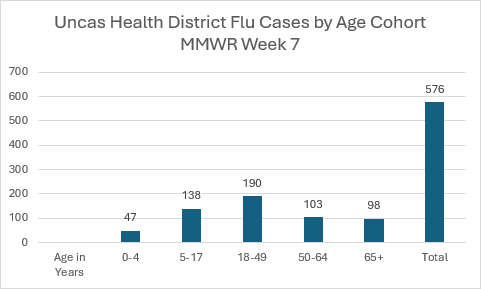
Nearly 200 influenza cases have been identified in the 11 cities and towns of the Uncas Health District this flu season, according to January 6, 2023, data from the Connecticut Department of Health. This week’s reported numbers mark an increase of 29 cases from the reporting period ending December 30, 2023 — and a total of 196 cases over the entire flu season.

A majority of reported cases were among those aged 18-49 and 65+.

It is important to note that influenza cases are only reported if there is a hospitalization or if the positive test comes from a minor.

flu numbers week 1 flu by age

As we enter the colder winter months, we may see a rise in cases of the influenza virus. However, there’s still time to bolster your defenses and keep yourself healthy.

The flu vaccine remains a crucial tool in protecting individuals from the potentially severe complications of influenza. Its importance is particularly amplified for those at higher risk, including:

  • Individuals 65 years of age and older
  • Those with chronic health conditions like heart disease, lung disease, diabetes, or asthma
  • Pregnant women
  • Children under five years old
  • Individuals who live with or care for those at high risk

Fortunately, flu vaccines are both safe and effective. With their ability to prevent millions of illnesses, hundreds of thousands of hospitalizations, and thousands of deaths each year, according to the CDC, they represent a powerful line of defense against the virus.

Therefore, we encourage everyone, especially those in the aforementioned high-risk groups, to prioritize getting vaccinated if they haven’t already. It’s not too late to shield yourself and those around you from the potential impact of the flu.

Remember, vaccination is a proactive step towards a healthier community. Let’s collectively choose prevention and navigate the winter months with greater resilience.

Find Our Mobile Health Team


January is National Cervical Cancer Awareness Month — What You Need to Know

woman with cervical cancer ribbon

January marks National Cervical Cancer Awareness Month. The American Cancer Society estimated there will have been about 13,960 new cases of invasive cancer diagnosed, and about 4,310 women will have died from cervical cancer in 2023. The 2020 CDC data for Connecticut shows there were 96 cases reported, equaling a cervical cancer rate of 4.8 per 100,000 women.

Anyone with a cervix is at risk for cervical cancer, increasing in people over the age of 30. Certain types of HPV are the main cause of cervical cancer. Screening tests and the HPV vaccine can help reduce the risk of cervical cancer. Click here to see more information about cervical cancer risk.

What is cervical cancer?

Cervical cancer starts in the cells lining the cervix — the lower part of the uterus (womb).

The cervix connects the body of the uterus (the upper part where a fetus grows) to the vagina (birth canal). Cancer starts when cells in the body begin to grow out of control.

The cervix is made of two parts and is covered with two different types of cells.

  • The endocervix is the opening of the cervix that leads into the uterus. It is covered with glandular cells.
  • The exocervix (or ectocervix) is the outer part of the cervix that can be seen by the doctor during a speculum exam. It is covered in squamous cells.

The place where these two cell types meet in the cervix is called the transformation zone. The exact location of the transformation zone changes as you get older and if you give birth. Most cervical cancers begin in the cells in the transformation zone.

Cervical Cancer Symptoms

Cervical cancer may not present with signs or symptoms in its early stages. Advanced cervical can cause bleeding or discharge from the vagina that is not normal for you. The best way to reduce risk is to see your doctor regularly, comply with screening recommendations, and report anything to your doctor that is not normal for you. See the attached documents for more detailed information.

Types of Treatment

If you are diagnosed with cervical cancer, you will be referred to a gynecologic oncologist to develop a treatment plan. Cervical cancer is treated in several ways. It depends on the kind of cervical cancer and how far it has spread. Treatments include surgery, chemotherapy, and radiation therapy.

  • Surgery: Doctors remove cancer tissue in an operation.
  • Chemotherapy: Using special medicines to shrink or kill the cancer. The drugs can be pills you take or medicines given in your veins, or sometimes both.
  • Radiation: Using high-energy rays (similar to X-rays) to kill the cancer.

 Insurance and Income: For those who are concerned they cannot afford care

Screening and treatment are covered under most insurance policies. But what if you, or someone you know, is uninsured or underinsured and cannot afford care? In Connecticut, the DPH has the Connecticut Early Detection & Prevention Program (CEDPP).

The CEDPP is an integrated program that brings breast and cervical cancer screening together with the WISEWOMAN, Colorectal Cancer, and Comprehensive Cancer programs, which helps promote healthy lifestyles for Connecticut Residents in order to decrease breast, cervical, and colorectal cancers, heart disease, hypertension, and other avoidable diseases. If you, or someone you know, needs to receive screening but cannot afford it, please go to the Early Detection and Prevention Program website to determine eligibility.

Cervical Cancer Facts


Flu Update: Reported Cases Exceed 160 Before Year-End (Dec. 30)

163 influenza cases have been identified in the 11 cities and towns of the Uncas Health District this flu season, according to December 30, 2023, data from the Connecticut Department of Health. This week’s reported numbers mark an increase of 30 cases from the reporting period ending December 23, 2023.

A majority of reported cases were among those aged 18-49 and 50-64.

It is important to note that influenza cases are only reported if there is a hospitalization or if the positive test comes from a minor.

flu cases increase flu cases by age

As we enter the new year, we may unfortunately see a rise in cases of the influenza virus in the coming weeks. The increase is often attributed to increased social interactions and travel during this period. However, there’s still time to bolster your defenses and keep yourself healthy!

The flu vaccine remains a crucial tool in protecting individuals from the potentially severe complications of influenza. Its importance is particularly amplified for those at higher risk, including:

  • Individuals 65 years of age and older
  • Those with chronic health conditions like heart disease, lung disease, diabetes, or asthma
  • Pregnant women
  • Children under five years old
  • Individuals who live with or care for those at high risk

Fortunately, flu vaccines are both safe and effective. With their ability to prevent millions of illnesses, hundreds of thousands of hospitalizations, and thousands of deaths each year, according to the CDC, they represent a powerful line of defense against the virus.

Therefore, we encourage everyone, especially those in the aforementioned high-risk groups, to prioritize getting vaccinated if they haven’t already. It’s not too late to shield yourself and those around you from the potential impact of the flu.

Remember, vaccination is a proactive step towards a healthier community. Let’s collectively choose prevention and navigate the winter months with greater resilience.

Check Out Our Events Page

Flu Update: 133 Reported Cases in District This Flu Season (Dec. 23)

133 influenza cases have been identified in the 11 cities and towns of the Uncas Health District this flu season, according to December 23, 2023, data from the Connecticut Department of Health. This week’s reported numbers mark an increase of 19 cases from the reporting period ending December 16, 2023.

It is important to note that influenza cases are only reported if there is a hospitalization or if the positive test comes from a minor.

It is likely that we will experience an increase in reports over the next week or so that will likely be related to holiday gatherings and travel. If you have not yet received your flu vaccine, it’s not too late.

Flu vaccination is especially important for people who are at high risk for complications from the flu, such as:

  • People 65 years of age and older
  • People with chronic health conditions, such as heart disease, lung disease, diabetes, or asthma
  • Pregnant women
  • Children younger than five years old
  • People who live with or care for people at high risk for complications from the flu

Flu vaccines are safe and effective. The CDC estimates that flu vaccination prevents millions of flu illnesses, hundreds of thousands of hospitalizations, and thousands of deaths each year.


Flu Update: 72 Reported Cases in District This Flu Season (Dec. 9)

uncas health district flu update

72 influenza cases have been identified in the 11 cities and towns of the Uncas Health District this flu season, according to December 9, 2023, data from the Connecticut Department of Health. This week’s reported numbers mark an increase of 18 cases from the reporting period ending December 2, 2023.

It is important to note that influenza cases are only reported if there is a hospitalization or if the positive test comes from a minor.

Flu cases are likely to continue rising throughout the winter months, so it is important to get your flu vaccination if you have not already.

Uncas Health District will be offering a number of Flu Vaccine Clinics throughout December.


Mondays in December (except Dec. 25)

12:00 p.m. – 5:00 p.m.

Please call (860) 823-1189 to make an appointment.


Tuesday, December 26 + Thursday, December 28

12:00 p.m. – 5:00 p.m.

Walk-ins accepted. No appointment is necessary. 

#LungCancerAwarenessMonth: Lung Cancer Screening Can Save Lives

doctor reviews ct scan of lungs

Lung cancer is the leading cause of cancer death in both men and women in the United States. It is estimated that more than 130,000 Americans will die from lung cancer in 2023.

Smoking is the leading risk factor for lung cancer, causing between 80-90% of all cases. Other risk factors include exposure to secondhand smoke, radon, and asbestos.

Lung cancer is often diagnosed late when it is more difficult to treat. However, there is now a low-dose CT scan that can be used to screen for lung cancer in high-risk individuals.

The US Preventive Services Task Force (USPSTF) recommends annual lung cancer screening with low-dose CT scans for adults aged 50 to 80 who have a 20-pack-year smoking history and currently smoke or have quit within the past 15 years.

Why is lung cancer screening important?

Lung cancer screening can help find lung cancer early when it is most treatable. Early detection can lead to better outcomes and longer survival rates.

For example, a study published in the New England Journal of Medicine found that lung cancer screening with low-dose CT scans reduced the risk of dying from lung cancer by 20%.

Who should get screened for lung cancer?

The USPSTF recommends lung cancer screening for adults aged 50 to 80 who have a 20-pack-year smoking history and currently smoke or have quit within the past 15 years.

A pack-year is a measure of cumulative smoking exposure. It is calculated by multiplying the number of packs of cigarettes smoked per day by the number of years smoked. For example, a person who smoked one pack of cigarettes per day for 20 years would have a 20-pack-year smoking history.

How does lung cancer screening work?

Lung cancer screening is a low-dose CT scan of the chest. The scan is quick and painless, and it takes only a few minutes.

The scan images are reviewed by a radiologist who looks for any suspicious areas that may be lung cancer. If a suspicious area is found, the radiologist may recommend further testing, such as a biopsy.

Smoking cessation programs

If you smoke, the best way to reduce your risk of lung cancer is to quit. Quitting smoking is not easy, but there are many resources available to help you.

Smoking cessation programs can provide you with support and guidance as you quit. These programs may offer counseling, nicotine replacement therapy, or other medications to help you manage cravings and withdrawal symptoms.

Lung cancer is a serious disease, but it is often preventable. If you smoke or used to smoke and are between 50 and 80 years old, talk to your doctor about getting screened for lung cancer.

Quitting smoking is the best thing you can do to reduce your risk of lung cancer. If you need help quitting, there are many resources available to you.

Additional Resources

Reminder: Flu Vaccinations for Young Children Required by Dec. 31

December 31 deadline

Attention Connecticut parents with children under 5: The clock is ticking on getting your little ones ready for flu season. To keep everyone healthy and happy in classrooms this winter, remember that Connecticut immunization regulations require a minimum of one dose of influenza vaccine for children under five each year between August 1st and December 31 to attend Connecticut schools.

Why is this important?

  • Protecting your child: Flu can be especially serious for young children, leading to hospitalization and even death. Vaccination is the best way to shield your little one from the flu.

  • Protecting the community: Children spread germs easily, so vaccinating them helps protect vulnerable individuals at school, like younger siblings or teachers with health conditions.

  • Staying in school: Missing school due to illness can disrupt learning and set kids back. Vaccination means fewer sick days and more fun exploring the world with their classmates.

Getting your child vaccinated is easy!

  • Check with your pediatrician: They can answer any questions you have and administer the vaccine during a regular checkup.

  • Other flu clinics: Many health departments and community centers offer free or low-cost flu shots. Find a clinic near you at ct.gov/flu.

  • Remember, the Connecticut Vaccine Program provides vaccines at no cost to all children under 19, regardless of insurance status.

Don’t delay – December 31st is coming fast! Make sure your child is flu-protected and ready for a healthy, happy school year. Let’s all work together to keep our classrooms germ-free and our kids smiling!

Additional tips:

  • Talk to your pediatrician about the specific type of flu vaccine recommended for your child’s age.

  • Schedule your child’s appointment early to avoid a last-minute rush.

  • Remember, even vaccinated children can still get the flu, so continue good hygiene practices like handwashing and staying home when sick.


FDA approves new COVID-19 vaccines that target circulating variants

Covid-19 vaccine and syringe

On September 11, 2023,  the U.S. Food and Drug Administration (FDA) took action approving and authorizing for emergency use updated COVID-19 vaccines formulated to more closely target currently circulating variants and to provide better protection against serious consequences of COVID-19, including hospitalization and death. Today’s actions relate to updated mRNA vaccines for 2023-2024 manufactured by ModernaTX Inc. and Pfizer Inc. Consistent with the totality of the evidence and input from the FDA’s expert advisors, these vaccines have been updated to include a monovalent (single) component that corresponds to the Omicron variant XBB.1.5.

What You Need to Know

  • Individuals 5 years of age and older regardless of previous vaccination are eligible to receive a single dose of an updated mRNA COVID-19 vaccine at least 2 months since the last dose of any COVID-19 vaccine.
  • Individuals 6 months through 4 years of age who have previously been vaccinated against COVID-19 are eligible to receive one or two doses of an updated mRNA COVID-19 vaccine (timing and number of doses to administer depends on the previous COVID-19 vaccine received).
  • Unvaccinated individuals 6 months through 4 years of age are eligible to receive three doses of the updated authorized Pfizer-BioNTech COVID-19 Vaccine or two doses of the updated authorized Moderna COVID-19 Vaccine.
  • The FDA is confident in the safety and effectiveness of these updated vaccines and the agency’s benefit-risk assessment demonstrates that the benefits of these vaccines for individuals 6 months of age and older outweigh their risks.
  • Individuals who receive an updated mRNA COVID-19 vaccine may experience similar side effects as those reported by individuals who previously received mRNA COVID-19 vaccines as described in the respective prescribing information or fact sheets.
  • The updated vaccines are expected to provide good protection against COVID-19 from the currently circulating variants. Barring the emergence of a markedly more virulent variant, the FDA anticipates that the composition of COVID-19 vaccines may need to be updated annually, as is done for the seasonal influenza vaccine.
  • The U.S. Centers for Disease Control and Prevention’s Advisory Committee on Immunization Practices will meet tomorrow (Sept. 12), to discuss clinical recommendations on who should receive an updated vaccine, as well as further considerations for specific populations such as immunocompromised and older individuals.
  • Manufacturers have publicly announced that the updated vaccines would be ready this fall, and the FDA anticipates that the updated vaccines will be available in the near future.

FDA headquarters in Maryland

“Vaccination remains critical to public health and continued protection against serious consequences of COVID-19, including hospitalization and death,” said Peter Marks, M.D., Ph.D., director of the FDA’s Center for Biologics Evaluation and Research. “The public can be assured that these updated vaccines have met the agency’s rigorous scientific standards for safety, effectiveness, and manufacturing quality. We very much encourage those who are eligible to consider getting vaccinated.”

The updated mRNA vaccines are each approved for individuals 12 years of age and older and are authorized under emergency use for individuals 6 months through 11 years of age. As part of today’s actions, the bivalent Moderna and Pfizer-BioNTech COVID-19 vaccines are no longer authorized for use in the United States.

Data Supporting the Updated mRNA COVID-19 Vaccines (2023-2024 Formula)

The mRNA COVID-19 vaccines approved and authorized today are supported by the FDA’s evaluation of manufacturing data to support the change to the 2023-2024 formula and non-clinical immune response data on the updated formulations including the XBB.1.5 component.

  • The updated mRNA vaccines are manufactured using a similar process as previous formulations. In studies that have been recently conducted, the extent of neutralization observed by the updated vaccines against currently circulating viral variants causing COVID-19, including EG.5 and BA.2.86, appears to be of a similar magnitude to the extent of neutralization observed with prior versions of the vaccines against corresponding prior variants against which they had been developed to provide protection. This suggests that the vaccines are a good match for protecting against the currently circulating COVID-19 variants.
  • The benefit-risk profile of previously authorized and approved mRNA COVID-19 vaccines is well understood as these vaccines have been administered to hundreds of millions of people in the United States.

Based on an evaluation of the totality of the evidence, the benefit-risk profile is favorable for individuals 6 months of age and older to receive an updated COVID-19 mRNA vaccine. Although serious outcomes from COVID-19 are less common in younger individuals, they do occur, and it has been demonstrated that recently receiving a COVID-19 vaccine reduces the risk of such serious outcomes.

Additional Details on Today’s Actions

Specifically, today’s actions include:

  • Approval of Comirnaty (COVID-19 Vaccine, mRNA) to include the 2023-2024 formula, and a change to a single dose for individuals 12 years of age and older. Comirnaty was previously approved as a two-dose series for individuals 12 years of age and older.
  • Approval of Spikevax (COVID-19 Vaccine, mRNA) to include the 2023-2024 formula, a change to a single dose for individuals 18 years of age and older, and approval of a single dose for individuals 12 through 17 years of age. Spikevax was previously approved as a two-dose series for individuals 18 years of age and older.
  • Authorization of Moderna COVID-19 Vaccine for emergency use in individuals 6 months through 11 years of age to include the 2023-2024 formula and lower the age eligibility for receipt of a single dose from 6 years to 5 years of age. Additional doses are also authorized for certain immunocompromised individuals ages 6 months through 11 years, as described in the fact sheets.
  • Authorization of Pfizer-BioNTech COVID-19 Vaccine for emergency use in individuals 6 months through 11 years of age to include the 2023-2024 formula. Additional doses are also authorized for certain immunocompromised individuals ages 6 months through 11 years, as described in the fact sheets.

The approval of Comirnaty (COVID-19 Vaccine, mRNA) (2023-2024 Formula) was granted to BioNTech Manufacturing GmbH. The EUA amendment for the Pfizer-BioNTech COVID-19 Vaccine (2023-2024 Formula) was issued to Pfizer Inc.

The approval of Spikevax (COVID-19 Vaccine, mRNA) (2023-2024 Formula) was granted to ModernaTX Inc. and the EUA amendment for the Moderna COVID-19 Vaccine (2023-2024 Formula) was issued to ModernaTX Inc.

Norwich Cooling Center to open for forecasted extreme heat September 5-7

heat advisory

With temperatures expected to reach the low 90s this week, the Norwich Cooling Center at the Rose City Senior Center will be open 5:30 a.m. until 4:00 p.m. on Tuesday, Sept. 5, Wednesday, Sept. 6, and Thursday, Sept. 7. The cooling center, located at 8 Mahan Drive in Norwich, has a capacity of 200.

Additionally, the Connecticut Department of Health has issued a reminder to all state residents to be very cautious when outside and to make sure they remain cool and hydrated.

From the DPH:

With temperatures anticipated to rise close to or into the low 90s this week, Connecticut Department of Public Health Commissioner Manisha Juthani, MD, is reminding individuals who will be spending time outside or in non-air-conditioned spaces to be cautious during periods of intense heat during the day.

The current forecast indicates that temperatures over this period will rise close to or into the low 90s, and the heat index is expected to reach into the mid-90s in certain inland areas of the state. On Monday, Governor Ned Lamont announced that he is directing Connecticut’s extreme hot weather protocol to be activated effective at noon on Tuesday, Sept. 5, and remaining in effect through 8 pm. on Thursday, Sept. 7.

“While Labor Day signals the unofficial end of summer, that doesn’t mean that we won’t continue to see high temperatures that will feel very hot and humid,” said Commissioner Juthani. “During this heat wave, residents should stay hydrated, take frequent breaks in cooler air-conditioned/shaded areas, and limit the time spent in direct sun. Additionally, more physical tasks should take place in the morning or evening, when the sun is less intense, and temperatures are cooler.”

Commissioner Juthani added that those who are experiencing heat stress should call for medical assistance immediately. Although anyone can be affected by heat-stress, those working outside are at a particularly high risk including:

  • Older individuals (over 65 years of age) who may not compensate for heat stress efficiently and are less likely to sense and respond to changes in temperature
  • Those performing frequent high-exertion tasks (lifting, digging, walking) who may become dehydrated quickly and experience more intense heat stress
  • Those who have underlying health conditions, especially heart disease, obesity, high blood pressure, diabetes, or who take certain medications that put them at risk

 Follow the steps below to stay cool and hydrated while working in the heat:

 Stay Cool

Keep your body temperature cool to avoid heat-related illness.

  • Stay in air-conditioned buildings as much as possible. If you must work outdoors, try to limit your outdoor activity to the mornings and evenings.
  • Avoid working in direct sunlight and wear lightweight, light-colored, and moisture-wicking clothing.
  • Check on family members, especially those most at risk often.
  • If you feel ill working in the heat, notify a family member and stop working.

Stay Hydrated

Because your body loses fluids through sweat, you can become dehydrated during times of extreme heat.

  • Drink more water than usual; do not wait until you are thirsty to drink more liquids.
  • Avoid drinking alcoholic beverages.
  • Drink about four cups of water every hour while working outside.
  • Remind others to drink enough water.


For more information about steps that employers and workers can take to reduce the risk of heat-related illness, contact the Connecticut Department of Public Health’s Occupational Health Program at (860) 509-7740 or email [email protected].